
Spartanburg Projected Release Dates
South Carolina public records show three related dates that answer different questions. A current SCDC inmate detail may show the exact field PROJECTED RELEASE DATE. The public SCDC calculator returns an Earliest Possible Release Date, which is a nonofficial estimate based on its assumptions. The current inmate detail can also display PROJECTED PAROLE ELIGIBILITY, the first possible consideration point rather than a promised physical exit.
Custody type controls which date has meaning. A person held before trial at the Spartanburg County Detention Facility usually has no sentence-based projected release date. Bond, a court order, dismissal, transfer, or later sentence controls that exit. A person serving a county-only sentence needs the jail’s calculation and commitment or discharge records. A state prisoner needs the South Carolina Department of Corrections record.
| Date or event | What it means | Best source |
|---|---|---|
| Projected Release Date | SCDC’s current calculation for a sentenced person still in state custody | Current SCDC inmate detail |
| Earliest Possible Release Date | A general calculator estimate that assumes maximum possible credits | SCDC public calculator |
| Projected Parole Eligibility | A possible Board consideration point | SCDC detail and parole law |
| County release time | The operational time county custody ended | Booking report and discharge order |
Find Spartanburg Release Date
Begin with the last known custodian. The ordinary SCDC inmate search covers people currently sentenced to and incarcerated in SCDC, with data represented as of the prior midnight. It excludes county detainees and released SCDC offenders. A person’s absence cannot establish release. The separate county record, court docket, or SCDC released list must answer those cases.
- Identify whether the person is in Spartanburg County custody, SCDC custody, or another system. Gather a booking number, SCDC ID, SID, or court case number when possible.
- For current SCDC custody, accept the official disclaimer, search the person, match identifiers, and open the detail record. Read
PROJECTED RELEASE DATEapart from parole and reentry eligibility. - For a county sentence, call the Spartanburg County Detention Facility at 864-596-2607. Ask for the controlling commitment record and the jail’s current credit calculation.
- For a pretrial detainee, check the Spartanburg Public Index and the correct court for bond, disposition, or later sentencing action.
- When the person has left SCDC, use the separate released search for the actual release date and type. Use a date range and understand that County means committing county.
The current SCDC interface shows how the future date is placed beside sentence, credit, parole, and reentry information.
Open the official SCDC current offender search before consulting the captured result layout.
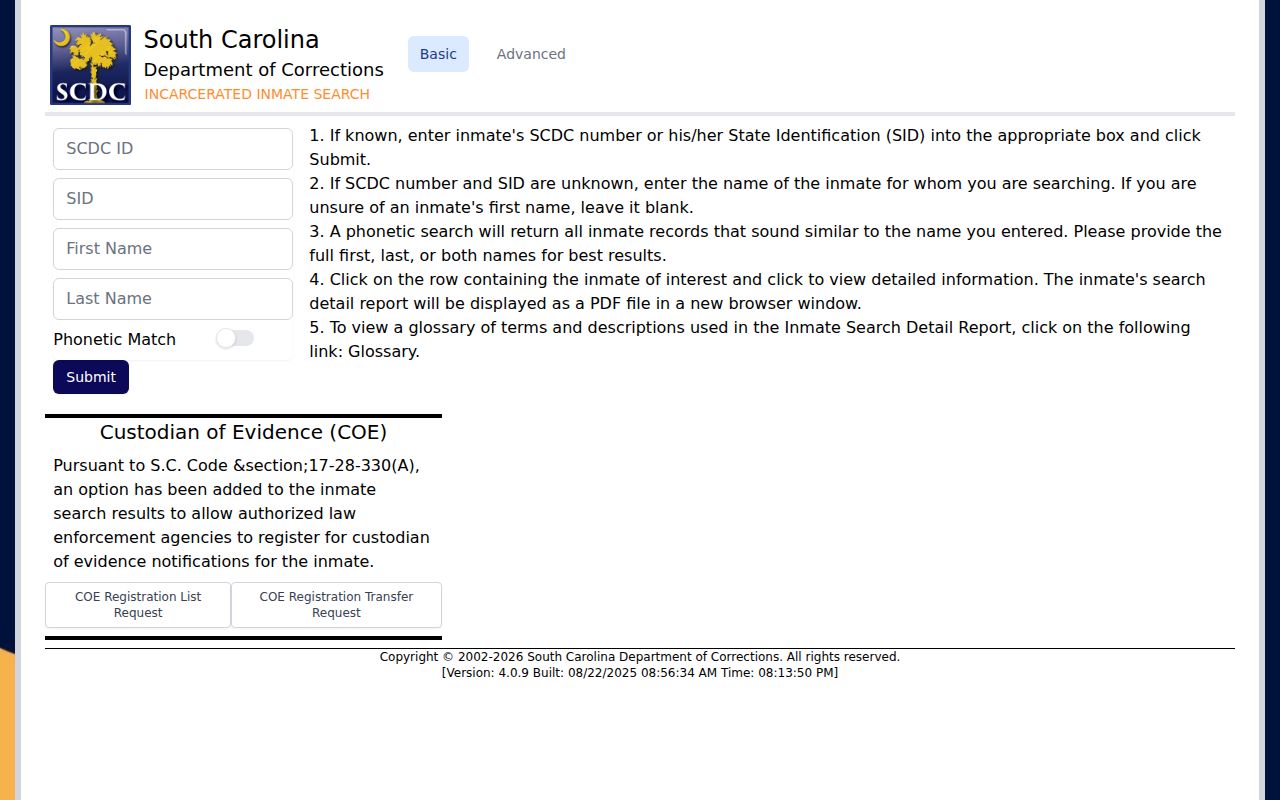
The surrounding fields matter because parole eligibility and supervised-reentry eligibility do not replace the projected release calculation.
Note: The current SCDC tool represents the prior midnight, so confirm urgent sentence-date questions with the agency rather than inferring a same-day change.
Spartanburg SCDC Release Calculator
The SCDC release-date calculator is for general guidance. It produces the earliest possible date under its inputs and assumes maximum possible credits. The calculator says it cannot calculate the date for someone already sentenced. It does not account for prior or later convictions and is not suited to Youthful Offender Act sentences.
That limit is critical for a Spartanburg County state prisoner. The calculator is not a substitute for the person’s current SCDC detail or a calculation from Inmate Records. Existing sentence questions should go to the SCDC Inmate Records Office at 803-896-8531. Search discrepancies go to Ombudsman@doc.sc.gov.
The official disclaimer spells out those limits before a user reaches the input screen.
Read the SCDC release calculator disclaimer for the source assumptions shown below.
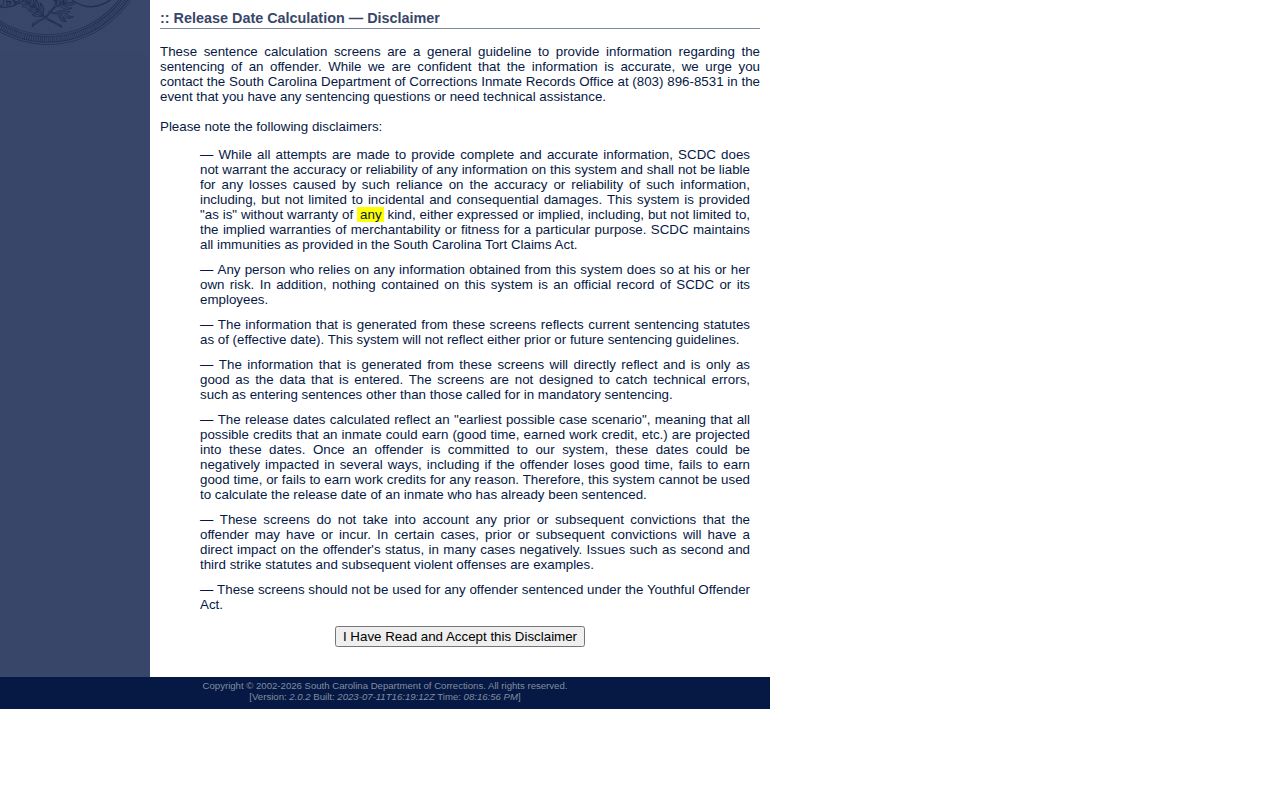
The warning is why a calculator date should be labeled as nonofficial and never presented as a scheduled jail exit.
Spartanburg Release Credit Floors
South Carolina Code Section 24-13-100 defines a no-parole offense as a Class A, B, or C felony, or an unclassified offense with a maximum term of twenty years or more. Section 24-13-150 sets an eighty-five-percent floor for a person convicted of a no-parole offense and sentenced to DOC custody, including custody under a designated local-facility agreement. Credits cannot reduce service below that floor.
The rule does not apply to every South Carolina sentence. The offense class, date of offense, mandatory minimum, actual imprisonment imposed, suspended portion, consecutive or concurrent terms, jail credit, and statutory exclusions all affect the calculation. Section 24-13-175 applies a 365-day year. A broad claim that every prisoner serves eighty-five percent would be wrong.
A projected release result should therefore be read with the offense and sentence details. When the record changes, ask SCDC which sentence input or credit event changed rather than trying to reverse-engineer the full date from a public summary.
Note: The statutory floor is offense-specific and cannot be applied to a Spartanburg County case without reviewing the controlling sentence.
Spartanburg Good-Conduct Release Credits
State and county sentences use sharply different credit rules. Under Section 24-13-210(A), an eligible SCDC inmate who was not convicted of a no-parole offense may earn twenty days of good conduct credit per month served when conduct requirements are met. A no-parole offender under subsection (B) may earn three days per month, but credits cannot breach the statutory floor. Some life and thirty-year mandatory-minimum sentences are excluded.
A county-only sentence follows subsection (C). It provides one day of credit for each two days served in a local detention facility or county public-works setting when conduct standards are met. The local official administers the credit and may forfeit it. The SCDC twenty-days-per-month formula must not be imported into a Spartanburg County jail sentence.
Credits are earned, not guaranteed at the maximum rate. Institutional offenses and rule violations can cause forfeiture. A posted projection may move when actual conduct credit differs from an earlier assumption. The county jail record or SCDC sentence calculation remains the controlling operational source.
- Good-conduct credit
- A statutory sentence reduction tied to satisfactory conduct and the applicable custody system.
- Forfeiture
- Loss of earned or potential credit after qualifying misconduct or a rule violation.
- No-parole offense
- An offense category defined by state law and subject to special release limits.
- Maxout
- The sentence endpoint after the official calculation of time and lawful credits.
Spartanburg Earned Release Credits
Section 24-13-230 permits an eligible SCDC inmate who is not serving a no-parole offense to earn from zero to one day of reduction for each two days of productive duty or qualifying education. The combined cap is 180 days per year. A no-parole offender may receive up to six days per month, or seventy-two days per year, while remaining subject to statutory floors and exclusions.
Education credit requires successful participation and is unavailable for a person convicted of a violent crime as defined in Section 16-1-60. Local detention follows another route. Section 24-13-230(E) requires a local official to allow from zero to one day for each two days in mandatory productive duty under published classification rates. Section 24-13-235 allows a county-authorized voluntary public-works program to credit one day per eight hours under local rules and stated court limits.
Research did not establish that every listed assignment operates in Spartanburg or that each participant receives the maximum rate. Confirm the program, classification, completed work, and approved credit with the Spartanburg jail. A generic statutory maximum cannot establish a person’s projected release date.
Why Spartanburg Release Rules Differ
The central Spartanburg County release-date quirk is not one formula but several. An eligible county sentence may receive one good-conduct day per two days served and a locally classified productive-duty credit. An SCDC sentence uses state-prison credit rules. A no-parole state offense also faces an irreducible eighty-five-percent floor when the statute applies.
The public tools add another distinction. The current SCDC record’s PROJECTED RELEASE DATE is part of an existing prisoner’s record. The calculator’s Earliest Possible Release Date is a general, nonofficial scenario. Mixing the county formula, SCDC formula, and public calculator can produce a plausible-looking date that has no official force.
The safest path is short: identify the custodian, obtain the controlling sentence, use the matching credit law, and ask the agency that maintains the calculation. Save the result date because later credit or court action can change it.
Spartanburg Release Date Changes
A projected date can move for lawful reasons. Jail credit may be corrected. Courts may clarify whether sentences run together or one after another. Offense classification, earned credit, forfeiture, discipline, later convictions, appeals, detainers, and supervision terms may also alter the result. The table separates common causes from the office that can explain them.
| Change | Effect on the date | Confirm with |
|---|---|---|
| Jail credit correction | Changes time already credited toward the sentence | Sentencing court and records office |
| Concurrent or consecutive ruling | Changes whether terms overlap or follow each other | Controlling court and SCDC Inmate Records |
| Credit earned or forfeited | Moves the calculated endpoint within statutory limits | County jail or SCDC |
| Detainer or hold | May prevent community release even when one sentence ends | Custodian and receiving agency |
| Parole action | May create a conditional release path, not a guaranteed gate date | Board, SCDPPPS, and SCDC |
A detainer is a hold or request from another authority. Spartanburg County can end its custody while another jail, SCDC, a federal agency, or immigration authority takes control. The first release record remains accurate, but it does not prove return to the community.
Confirm Spartanburg Actual Release
For completed SCDC releases, use the SCDC Released Inmate Search. It requires from and to dates plus a county selection. Its result shows release date and release type, while County means committing county rather than release site or destination. The ordinary current locator excludes released offenders.
For Spartanburg County jail custody, ask for the booking report and commitment or discharge order. The booking report supplies the operational release date and time. The discharge order supplies the court, legal authority, judge, and date. A court disposition may explain the outcome without recording the precise moment the person left the jail.
Notification records are leads. The resolved VINELink Inmate Search can help track a custody change, but a status alert is not the final sentence calculation. When date records conflict, the custodian’s current record and governing court order take priority.
Note: Record the projected date and the later actual release date separately so a changing estimate does not overwrite the custody history.