
Spartanburg VINELink Release Coverage
South Carolina VINE, accessed through VINELink, receives custody or supervision information from county detention centers, the South Carolina Department of Corrections, and the South Carolina Department of Probation, Parole and Pardon Services. That coverage makes it useful when a Spartanburg County case moves from the county detention facility to SCDC or later to state supervision. It is a status and notification network, not a single certified release archive.
Coverage has limits. South Carolina VINE excludes juveniles and mental-health facilities. Federal BOP, U.S. Marshals, and ICE custody are separate systems. A person released from the Spartanburg County Detention Facility may still be held by another agency, and a person released from SCDC may remain under SCDPPPS supervision. Read the named custodian and event rather than treating every release label as freedom from all legal control.
The direct South Carolina VINELink portal and the state telephone service at 1-866-727-2846 provide the main access channels. Both are meant for a specific person. They do not function as a countywide list of everyone released on one date.
Search Spartanburg Inmates on VINELink
Begin with the person’s legal first and last name or an offender number. A middle initial or date of birth can help distinguish matches, but use only the detail needed to choose the correct adult record. Do not publish extra identity data. The last known custodian also matters because a transfer can create a new agency record or a short gap between feeds.
- Open the South Carolina portal or call the statewide VINE number.
- Choose South Carolina and the adult-offender search.
- Enter the legal name or offender number, adding a middle initial or birth detail only when needed.
- Compare the matches and select the person whose identifier and custody context fit.
- Read the custody status, location, and notification choices, then note the date and time observed.
- If the record reports release or no custody information, confirm the exact date and type with the source agency.
Multiple matches should be resolved through stable identifiers and the expected facility, not by guessing from a similar name. If the person recently moved from the county jail to SCDC, search the new custodian too. The full Spartanburg County released-inmate search explains how to connect the VINE event with county, state, supervision, court, and federal records.
Note: Save the observation time because VINELink status can change after a transfer, release, or agency feed update.
Spartanburg VINELink Release Fields
VINELink reports the status information supplied through participating agencies. The exact display can vary with the custodian and available notification types. Its useful fields answer who the network matched, which agency reports the person, what custody state is shown, and which future events can trigger an alert. They do not replace a signed discharge order or a booking report with the jail’s release timestamp.
| VINELink item | How to read it |
|---|---|
| Name or offender identifier | Helps distinguish the intended adult record from similar names. |
| Custody status | Shows the event or status currently reported by the participating agency. |
| Facility or location | Identifies the reporting custodian or place when supplied. |
| Release or custody-change event | Provides a notification lead that should be checked against the source record. |
| Notification options | Shows which phone, email, text, or TTY registration methods are offered. |
The state FAQ says that no available custody information may be treated as a sign that the person was released. Apply that point cautiously. A spelling mismatch, excluded system, transfer-feed gap, completed supervision, or data delay can also produce no result. The safe statement is that VINE had no custody information at the recorded observation time.
The official VINELink search and registration screen is shown in the captured view below.
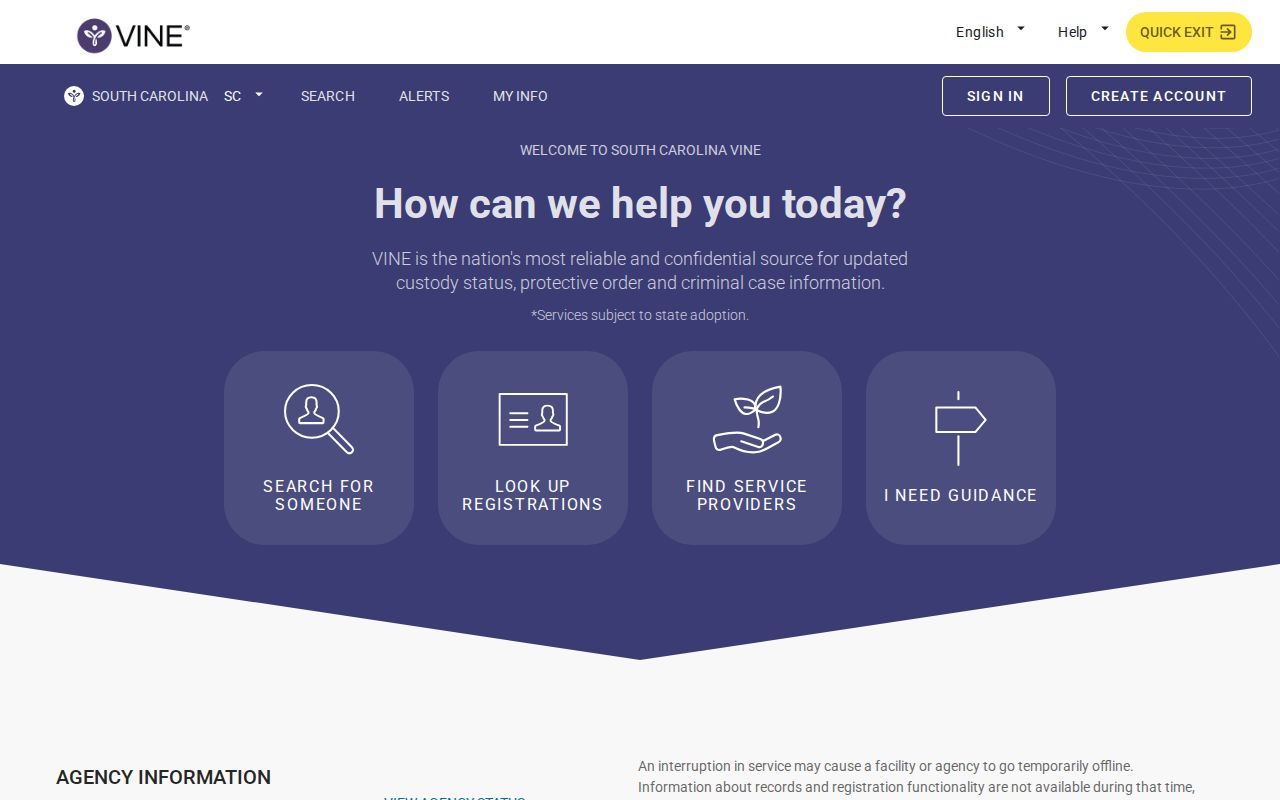
The image connects the person-specific search state with the notification choices that appear after the correct record is selected.
Register Spartanburg Release Alerts
Registration begins on the matching person’s record. Choose the available custody-change or release notification, then select a contact method. The portal may offer phone, email, text, or TTY. Use a valid destination that is checked often. An alert is most helpful when the stored contact detail remains current.
- Confirm that the selected adult record belongs to the intended person.
- Choose the custody-change or release event offered for that record.
- Select phone, email, text, or TTY as available and enter accurate contact information.
- For phone registration, create the four-digit PIN used to acknowledge an automated call.
- When a call arrives, enter the PIN to acknowledge it and stop repeat calls.
- After any transfer to a different agency, locate the new record and register again.
Unacknowledged phone calls may repeat for up to 48 hours. The official FAQ says email and text registration do not use the telephone PIN. A PIN acknowledges receipt of the call; it does not verify the facts behind the event. If the message concerns immediate personal safety, use the appropriate emergency or law-enforcement contact rather than relying on a database alone.
Note: VINELink registration tracks the selected participating record, so contact details and the reporting custodian must both stay current.
Spartanburg Transfers Need New Alerts
South Carolina’s most important local registration caveat is that alerts do not automatically follow a person from one agency to another. If the Spartanburg County Detention Facility transfers someone to SCDC, the county registration may end with that county custody event. Search for the SCDC record after intake appears and register again with the new custodian. A brief gap can occur while agency data catches up.
The same rule applies when responsibility shifts to SCDPPPS supervision. A state-prison release and an active supervision case are related but distinct records. SCDPPPS data can reflect the prior day, so a new supervision status may not appear at the exact moment SCDC custody ends. Preserve the SCDC release event, then confirm the supervision record through the appropriate state agency.
For state-prison crime-victim notifications, SCDC directs users to its Division of Victim Services at 1-800-835-0304. That program is a specific South Carolina layer beyond general VINE registration. The South Carolina VINE FAQ documents the transfer and registration cautions. Re-registering is not duplicate work; it is how notification coverage follows the new custodian.
Spartanburg VINELink Result Limits
VINELink answers one narrow question: what status or event does the participating network currently report for this person? It does not certify the exact physical-release time, the legal authority for discharge, the final court disposition, or the absence of all custody. A transfer, system exclusion, spelling problem, or data lag can create an incomplete picture. The result must be matched to the agency that owns the underlying fact.
County and state searches also serve different populations. The live Sheriff view concerns county detention. The ordinary SCDC locator shows people currently sentenced to and incarcerated in state prison, with data from the previous midnight. The separate SCDC Released Inmate Search documents completed state releases by date range and committing county. VINELink can connect event awareness across those systems, but it does not merge their records.
Federal custody remains outside the state network. A person removed from Spartanburg County on a federal matter may require the federal docket, clerk, U.S. Marshals information, or BOP locator. An ICE transfer requires the official detainee locator. Never interpret a state-network absence as proof that no federal or immigration custodian exists.
Confirm Spartanburg Release Records
For a county-jail event, compare the VINE observation with the official Spartanburg Sheriff booking search and call the detention facility at 864-596-2607. Then request the booking report and commitment/discharge order. The booking report supplies the operational release date and time. The discharge order identifies the court, authorization, judge, and order date. Those records answer questions a notification cannot.
The Spartanburg County FOIA form is the county request route. Give the legal name, booking or case number if known, and an approximate custody range. Ask for public release type, discharge authority, and transfer destination where releasable. Protected details may be redacted. The Sheriff’s Detention Services page explains why online jail information can change quickly.
For a completed SCDC release, use the dedicated released list with required from and to dates and County=Spartanburg. In that tool, Spartanburg means committing county, not necessarily the release facility or destination. Match SCDC ID or SID. If community supervision may follow, check SCDPPPS and contact its local office when same-day status matters.
Note: A court disposition explains the legal result, while the booking or corrections release record establishes the custodian’s recorded exit event.
Spartanburg Notification System Boundaries
Other South Carolina public systems should not be treated as general release alerts. The SLED Sex Offender Registry applies only to people with a legal registration duty. It can corroborate listed community registration information, but it is not a county release list and does not prove that a person is outside every form of custody. Juvenile and mental-health placements remain outside VINE coverage.
Use a simple source hierarchy when results conflict. A signed discharge order is strong evidence of legal authority. A booking report is strong evidence of the county jail’s recorded release time. The receiving agency’s current record is strong evidence of continued custody. VINE is useful for a reported event, and a court docket is useful for disposition. Each source should be described only for the fact it was designed to show.
- Custody notification
- An automated report of a participating agency’s status change, not a certified release order.
- Discharge
- The documented end of the stated custodial sentence or authority.
- Transfer
- A move between custodians that ends one agency’s control while another continues confinement or supervision.
- Supervision
- Community-based legal oversight that can continue after physical jail or prison release.
A precise final note identifies the person matched, the agency reporting, the status seen, and the observation time. If another record later changes that understanding, update the conclusion rather than forcing all systems to agree at the same moment.